Track & Field
ハイパーオリンピック
- Year
- 1987
- Developer
- Konami
- Publisher
- Konami
- Platform
- FC / NES
- Hardware
- Family Computer (8-bit)
- Genre
- Sports
- Players
- 1-2 players (alternating)
- Controls
- D-pad + A / B (alternating taps to run)
- Series
- Track & Field series
Gameplay Screenshots
About This Game
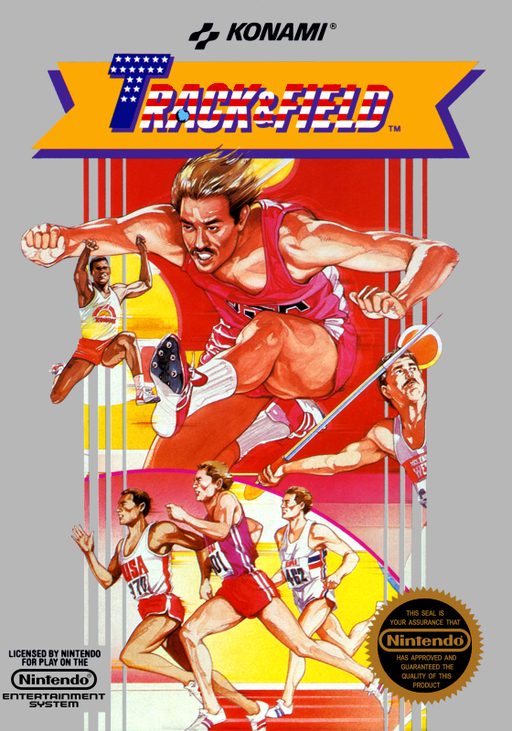
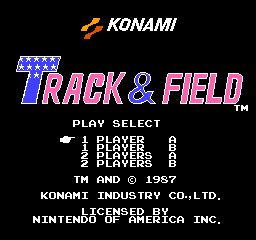
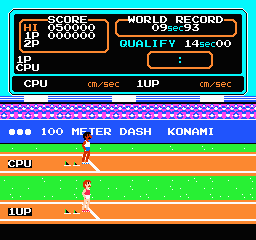
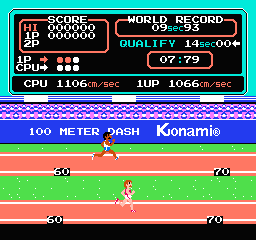
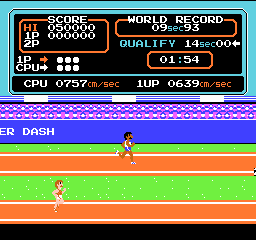
Track & Field is Konami's conversion of its arcade athletics game, released in Japan as Hyper Olympic. It is six events - 100m sprint, long jump, javelin, 110m hurdles, hammer throw and high jump - and it is built entirely around one input idea: alternate the two buttons as fast as you can.
That mechanic is why the game is remembered. Running speed is literally the rate of your button presses, so the arcade original was famously played with a pencil rolled across the buttons, and the NES version is just as physical. Each event layers one more input on top: the long jump needs the take-off timed at the board, the javelin needs the release angle, the hurdles need a jump over each one without losing rhythm. Two players alternate and the game tracks personal bests, which is why it survived as a party game long after the arcade cabinets stopped earning.
- Running speed determined directly by button-tap rate
- Six events, each adding a timing input on top of the tapping
- Two-player alternating competition with personal bests recorded
- Early example of a rhythm-as-mechanic sports game
Version History
- Arcade original (Hyper Olympic)1983
Konami's coin-op, released worldwide as Track & Field.
- Famicom Japanese version (Hyper Olympic)1985
Japanese console release under the Hyper Olympic name.
- NES US version1987-04
The version on this page, published by Konami.
Tips & Strategy
Alternate, do not mash one button
Speed comes from the alternation between A and B. Pressing one button fast scores nothing like the same rate alternating.
Time the take-off at the board
The long jump is decided entirely by when you jump. Leaving it late is worth more distance than playing safe.
Angle the javelin up
The release angle changes the arc. Around 45 degrees carries; throwing flat wastes the run.
Reset your rhythm after each hurdle
Hitting a hurdle kills your speed. Jump early and rebuild the tap rate rather than trying to carry a broken rhythm.
Download Resources
Resource packs for this game are provided through the button below.
⬇ Coming soonSimilar Games
Browse all: FC Games